

- Country
- Ireland
- Publication type
- Article
- Thematic area
- Implementation & enforcement
- Sanctions compliance & due diligence
Financial institutions play a central role in international trade, facilitating payments connecting businesses across borders. As EU sanctions evolve, those institutions must look beyond who is sending or receiving payments to understand the underlying trade and identify potential sanctions risks. For small and medium-sized enterprises (SMEs), understanding these compliance demands can help them prepare for future questions they may face.
The Central Bank of Ireland (thereafter, the ‘Central Bank’) sees these compliance challenges through its role as one of Ireland’s National Competent Authorities (NCAs) for EU sanctions, responsible for administering financial sanctions in relation to financial institutions. Through its work providing guidance, assessing derogation applications, and receiving sanctions reports, its Financial Sanctions Team gains direct insight into the practical difficulties firms encounter.
We spoke with Vivian Meacham, who leads the team, about how sanctions are reshaping financial institutions’ compliance work, the challenges facing SMEs, and how the Central Bank and the EU Sanctions Helpdesk can support them.
How have EU sanctions affected financial institutions?
"EU sanctions have increased the compliance considerations of financial institutions (including SMEs), particularly given the breadth of sanctions measures (i.e. 21 Russian sanctions packages) since 2022 alone. Complying with sanctions can be difficult especially when considering the inherently cross-border nature of financial transactions. This creates complex and novel considerations for compliance functions. For instance, when you consider the complexity of navigating the interplay between EU obligations and those of other jurisdictions such as the US and UK. This multifaceted compliance landscape has reshaped how financial institutions operate.
There has been an increase in the operational and compliance requirements in firms. Financial institutions must now conduct far more rigorous screening of customers, counterparties and transactions against EU sanctions lists, supported by enhanced due diligence and appropriately calibrated monitoring systems to prevent breaches. The level of reporting and documentation required to meet compliance obligations has increased significantly, sometimes calling for dedicated resources and expertise across institutions.
The expansion of trade and sectoral sanctions has particularly transformed compliance operations, moving beyond simple entity-list screening to require deep understanding of transaction substance, supply chains and end-use. Financial institutions must now assess not only who is involved in transactions, but what is being traded and how it will be used, necessitating multi-layered analysis of commodities, goods classifications and sectoral exposure across complex supply chains."
What are the main challenges you are seeing for SMEs?
"The complex and rapid evolution of sanctions regimes creates challenges for SMEs in meeting their compliance obligations. For SMEs with limited in-house expertise and resource constraints, this presents a challenge.
The core challenges that SMEs encounter include resource constraints for building compliance infrastructure, limited or no access to appropriate sanctions screening tools and technology, and difficulty understanding increasingly complex and evolving sanctions regimes.
As a National Competent Authority (NCA) we can see that circumvention techniques have evolved substantially in recent years, requiring institutions to continuously reassess sanctions risk. This can be an onerous task for SMEs lacking dedicated compliance teams and sanctions-specific expertise. Unlike larger firms that may deploy teams of experts to monitor regulatory changes and maintain compliance systems, SMEs must often rely on generalist staff or external advisors, creating both cost and knowledge gaps. Additionally, SMEs typically have limited access to the technology solutions that could help reduce compliance burden, leaving them vulnerable to inadvertent breaches whilst struggling to keep pace with regulatory updates."
What is the Central Bank doing to help SMEs? What limits are in place?
"The Central Bank plays a vital compliance support role for the SME and broader business community through direct engagement with those seeking clarity on sanctions compliance obligations. We process individual queries, provide sector-specific guidance, conduct industry engagement forums to share compliance expectations and sanctions evasion typologies, analyse breach reporting to identify vulnerable areas, and coordinate with other NCAs and enforcement authorities across the EU and third countries. This multifaceted approach ensures SMEs receive practical support whilst helping us identify and address emerging sanctions compliance risks.
However, important limits exist on the support we can provide. We cannot waive or modify EU sanctions obligations, which are set at EU level and apply uniformly across member states, nor can we provide the detailed, case-by-case guidance available through the EU Sanctions Helpdesk. Whilst we can clarify regulatory expectations, we cannot substitute for institutions' own compliance responsibilities or reduce their obligation to implement robust internal controls.
SMEs must ultimately bear responsibility for understanding their sanctions obligations and implementing appropriate compliance frameworks. We encourage smaller entities to complement Central Bank guidance with engagement with the EU Sanctions Helpdesk, industry associations, and external compliance advisors where necessary."
What can SMEs do to effectively manage their sanctions risk?
"Our team recognises the compliance challenges facing SMEs and recommends considering a structured, risk-based approach to managing sanctions risk proportionate to their size and capacity. SMEs may wish to adopt compliance frameworks reflecting their specific business models, customer profiles, and transaction types, rather than attempting to replicate larger institutions' complex systems. This proportionate approach can help smaller firms allocate resources effectively whilst maintaining appropriate controls.
We encourage SMEs to consider investing in regular staff training and awareness campaigns to build internal sanctions knowledge and create a compliance culture. Training should aim to ensure that relevant staff understand their sanctions obligations, can identify high-risk transactions, and know escalation procedures. Similarly, SMEs may benefit from implementing transaction monitoring appropriate to their scale and nature of their business, utilising available screening tools and establishing procedures for flagging suspicious activity that may indicate sanctions evasion.
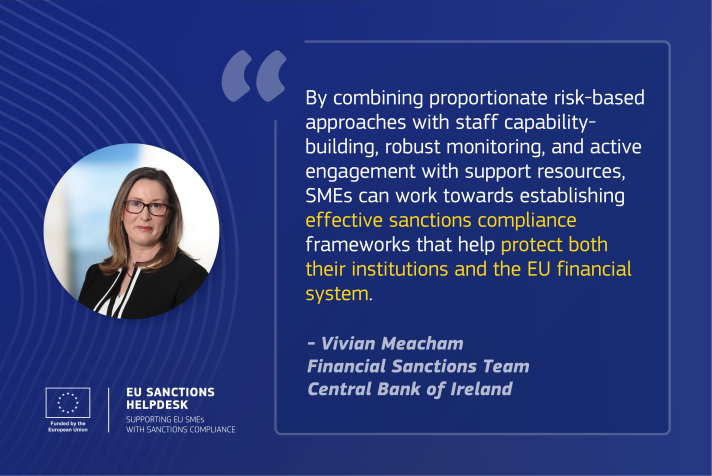
SMEs should consider actively engaging with available support resources to help manage their compliance obligations, including Central Bank guidance, the EU Sanctions Helpdesk's free webinars and resources, industry associations and external advisors. We encourage participation in industry forums and peer networks to share experiences and best practices. By combining proportionate risk-based approaches with staff capability-building, robust monitoring, and active engagement with support resources, SMEs can work towards establishing effective sanctions compliance frameworks that help protect both their institutions and the EU financial system."
How does an NCA like the Central Bank of Ireland see the Sanctions Helpdesk?
"Given the challenges SMEs face in managing sanctions compliance (e.g. resource constraints, limited access to screening tools and keeping pace with the EU sanctions packages since 2022), the EU Sanctions Helpdesk represents a vital resource. The Central Bank of Ireland has been a strong advocate for the Sanctions Helpdesk since its inception, having participated in the initial Pilot Programme in 2023.
The Helpdesk's added value is substantial for SMEs lacking dedicated compliance resources. It provides free, personalised support enabling smaller businesses to access expert guidance on complex sanctions regimes without incurring substantial external advisory costs. Serving as both an educational resource and compliance assessment tool, the Helpdesk helps SMEs develop proportionate compliance frameworks tailored to their circumstances.
For Irish SMEs, we strongly recommend engaging with the Helpdesk as part of a comprehensive sanctions compliance strategy. Combined with robust internal training, risk-based transaction monitoring, and industry engagement, the Helpdesk can make a real difference in helping smaller institutions meet their sanctions obligations effectively."
Get sanctions support
Are you interested in the Helpdesk’s sanctions compliance support? We can:
- Answer your questions on the applicability of EU sanctions.
- Offer you guidance on performing sanctions due diligence.
- Undertake sanctions due diligence for you, free of charge, if you encounter red flags or need support.
Visit our Support Service page to get started with the free service. This service is funded by the European Union, and you can learn more about the Helpdesk here.
Partners: If you would like to collaborate or exchange on events or other ideas to help SMEs with sanctions compliance, we would love to hear from you here.