- Country
- Sweden
- Greece
- Publication type
- Article
- Thematic area
- Raw materials & manufacturing
- Transportation & logistics
- Sanctions compliance & due diligence
Introduction
Sanctions compliance can be complex, fast-moving and resource intensive. To help businesses navigate these challenges, the EU Sanctions Helpdesk has been supporting European small and medium-sized enterprises (SMEs) and other organisations in complying with EU restrictive measures since March 2025.
Learning from SMEs’ experience
Beyond one-to-one support, the Helpdesk works with SMEs dealing with real-world sanctions challenges to share lessons and best practices. Through events, interviews, and its podcast series, the Compliance Corner, the Helpdesk captures real tips and tricks that other SMEs can take advantage of.
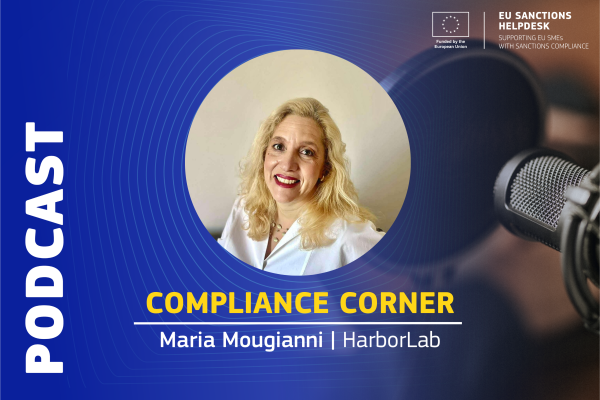
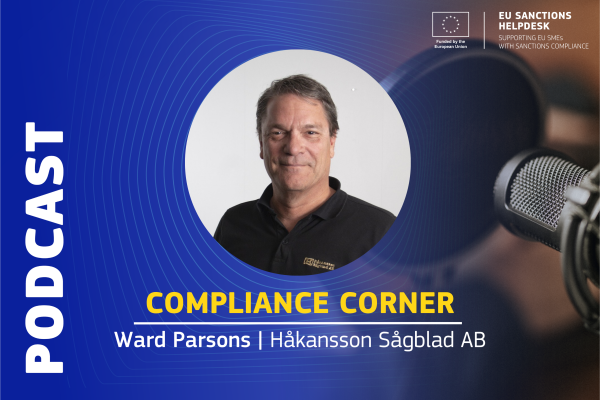
Maria Mougianni of HarborLab and Ward Parsons from Håkansson Sågblad were the first to share their stories in the Compliance Corner podcast series, representing Greek and Swedish SMEs from very different sectors: shipping/harbour operations and small-scale, high-end manufacturing respectively. Their stories show that, regardless of sector or size, sanctions compliance is a shared challenge and one that SMEs do not have to face alone.
Navigating complexity in the maritime sector: HarborLab’s experience
Maria has experience in financial services, with a focus on sanctions governance and enforcement in the maritime industry. Her company offers shipping companies ways to manage the disbursement account process with transparency, consistency, and operational control. Sanctions compliance is obviously a critical part of that. According to her, a key lesson learned is:
Prepare for constant change. Sanctions frameworks evolve quickly and without much warning. A flexible mindset and an adaptable internal architecture are key. This includes keeping policies under continuous review and ensuring company teams are equipped to handle regulatory shifts.
Maria also shared her experience in taking advantage of the Helpdesk’s Support Service. In her words:
Another tip is to leverage external expertise. One of the most impactful choices we made was to make full use of public resources like the EU Sanctions Helpdesk. Their guidance has been essential in validating our internal approach and clarifying how certain obligations apply to our business model. They have helped us navigate complex interpretations, for example, around ownership disclosures and jurisdictional applications, ensuring that our decisions are well-reasoned and appropriate.
A different sector, similar challenges: manufacturing in Sweden
For his part, Ward Parsons of Håkansson Sågblad related his own experience of dealing with sanctions as a small company with limited internal resources to handle these situations.
We're a small company. We're actually the smallest quality player we believe in the world. We've only got 34, 35 guys, including all the factory and all of the front office staff…Our turnover is about 10 million euro a year…And we export 95% of our material around the world.
He noted a common problem: a lack of clarity about what exactly was needed in order to show that certain transactions or customers were acceptable to deal with.
The bank started talking to us about who your customers are.... They kept coming back to us saying, well, what about this situation? What about that situation? And the banks kept pushing back saying, well, you have to do more, do more, but they wouldn't tell us what.
Ward and his company ended up creating their own internal processes to compile information for the banks. Some of what they did can be found in an article published by the EU Sanctions Helpdesk. But he also reached out to the Helpdesk team for further support. As he describes:
The Helpdesk Support Service helped create the paper trail to make sure that we have the right documentation, the owner certificate, the export declarations, the re-export agreements, the HS codes, and what products are in the codes. So, it helped us actually keep that data organised.
What’s next?
Are you a business support organisation interested in partnering with the EU Sanctions Helpdesk to support EU SMEs? Please reach out for partnerships via this form.
Are you an SME dealing with similar sanctions issues? You can take the following steps:
Action 1
Make sure to check out the EU Sanctions Helpdesk website, including publications and resources. The podcast episodes are also a great listen, as they go into further detail about other tips and best practices.
Action 2
Head over to the EU Sanctions Helpdesk’s free, personalised Support Service to discuss your own situation with our team. The Support Service helps SMEs to:
- Understand the applicability of EU restrictive measures to their specific business activities
- Receive guidance and support on sanctions due diligence, free of charge, when red flags arise or reassurance is needed
Action 3
Watch our new explainer video to familiarise yourself with the Support Service’s online portal.