

- Country
- Germany
- Publication type
- Article
- Thematic area
- Sanctions compliance & due diligence
EU sanctions are becoming increasingly complex. For German small and medium-sized enterprises (SMEs), staying compliant is no longer straightforward. Beyond adapting to supply chain shocks and identifying new markets, companies must also navigate evolving regulations, indirect exposure risks and growing compliance obligations, even when they do not trade directly with sanctioned countries such as Russia or Belarus.
To better understand these challenges and how SMEs can respond in practice, we spoke with Viktoriia Kitsun, Team Coordinator for Foreign Trade at the Chamber of Industry and Commerce (IHK) in Baden-Württemberg, which plays a key role in supporting German companies on sanctions compliance.
How do you see the overall state of EU sanctions for SMEs?
"EU sanctions, especially those targeting Russia and Belarus, have created additional challenges for SMEs. It is no longer only about finding new markets and supply chains, but also about navigating the increasing complexity of sanctions and the frequent changes introduced with each new package. SMEs have had to comply with more regulations, even if they do not export directly to Russia or Belarus. With every new round of sanctions, compliance obligations have become more complex."
How has this impacted the Chamber’s role and the support you offer?
"For us at the IHK, the demand for consultations continues to grow. In some cases, we first need to explain the overall sanctions regime before we can examine individual cases in detail, as companies are not all at the same level of knowledge. Our consultations have become longer and require more preparation. We are also offering more informational events, such as our annual Export Control Week, which will take place in June 2026 for the third time due to consistently high demand."
What are some specific challenges that you see German companies frequently grappling with?
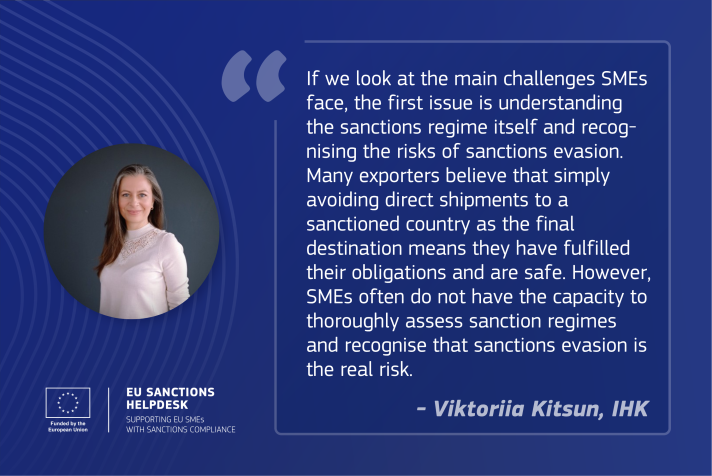
"Many companies assume that if they are not exporting goods for military end-use or to sanctioned individuals, then sales to third countries are automatically risk-free, even when dual-use goods are involved. Even more complex are sales of listed goods within the EU or to partner countries. In such cases, there are often no obvious red flags, yet companies can still become involved in sanctions circumvention without realising it.
The implementation of the No-Russia Clause was also particularly challenging for SMEs in the beginning. Because many of them sell goods without using written contracts, integrating the No-Russia Clause as part of an offer and acceptance required a different approach. However, many SMEs did not know which methods of implementation were considered acceptable."
Building on that, what kind of support do SMEs need to handle those challenges?
"SMEs need more support when it comes to raising awareness about sanctions—why they matter, why it is essential to know your customer, and which compliance obligations they must fulfil. Another challenge concerns internal compliance processes. Due to their size, SMEs often have only a handful of employees who must manage very complex topics. They are expected to handle operational tasks while also staying informed about the latest changes in sanctions regulations.
Another major need for all parties involved is clear and practical guidance on how to implement sanctions at the operational level. For example, in the beginning, it was unclear which type of proof of non-Russian origin would be accepted for steel imported from third countries into the EU. This created considerable uncertainty, particularly for German companies in the steel and related industries. In the Heilbronn-Franken region, these sectors form a core part of the local economy."
Can you share any tips or recommendations for companies to manage their sanctions compliance?
"Well-organised processes and clearly defined responsibilities within a company are essential. Export control cannot be treated as a side issue. There are many different sources that provide information on sanctions, such as the websites of the European Commission, the BAFA (Bundesamt für Wirtschaft und Ausfuhrkontrolle) and the BMWE (Bundesministerium für Wirtschaft und Energie).
It is particularly important to pay attention to red flags that indicate the risk of sanctions evasion, such as unusual communication patterns, abnormal order volumes, uncommon shipment routes and irregular payment requirements. A more thorough background check, especially when dealing with new clients, can also help reduce these risks.
Newsletters from relevant institutions or from your local Chamber of Industry and Commerce can help you stay informed about new sanctions or upcoming sanctions packages. In addition, consultations with your Chamber of Industry and Commerce can provide SMEs with an initial assessment of their situation. There are also other free support options, such as the EU Sanctions Helpdesk."
What do you think about the added value of the EU Sanctions Helpdesk and the free personalised Support Service?
"The assessment of difficult cases by the EU Sanctions Helpdesk is particularly helpful. Both companies and institutions can contact the Helpdesk for free, personalised support. As a Chamber of Industry and Commerce, we also make use of these services because we value assessments from a team of experts whose primary focus is sanctions. The added value of such cooperation is that SMEs save valuable time, receive reliable evaluations on which to base further decisions, and learn — through the Helpdesk’s responses — how to approach the examination of sanctions regimes themselves."
We highly appreciate Viktoriia’s insights. As she noted, sanctions compliance poses particular challenges for SMEs, as they often lack the staff, budgets, or both, to handle things completely in-house. That is why getting support from a variety of sources, including from Chambers of Commerce like IHK, is so essential.
Get sanctions support
Interested in the Helpdesk’s sanctions compliance support? We can:
- Answer your questions on the applicability of EU sanctions
- Offer you guidance on performing sanctions due diligence
- Undertake sanctions due diligence for you, free of charge, if you encounter red flags or you simply need the support
Visit our Support Service page to get started with the free service.
Partners: If you would like to collaborate or exchange on events or other ideas to help SMEs with sanctions compliance, we would love to hear from you here.